

Follow the steps below to see how easy it is to build a project budget report in OnePager using your project data from Smartsheet. If you don’t already have OnePager, you can download a 15-day free trial to see how it works.
-
In Smartsheet, we have a project with a column for the budgeted cost, the actual cost, and the variance in cost between budget vs. actual:

-
Launch OnePager using the desktop icon:

-
On the Start screen, click NEW to start building a new OnePager chart from Smartsheet:

-
To connect OnePager to Smartsheet, go to Select > Browse Smartsheet

If you haven't connected to Smartsheet through OnePager in the past, Smartsheet will ask you to confirm your username and password.
-
Select the Smartsheet project that you want to import into OnePager, and click OK

If you haven't connected to Smartsheet through OnePager in the past, Smartsheet will ask you to confirm your username and password.
-
Give your report a name, and decide whether you want to select all of the rows from Smartsheet, or just a few.

In this example, our Smartsheet project is pretty small, so we will import all of the rows from Smartsheet. If your project is larger, you can use a checkbox field to decide which Smartsheet rows to include, and which to exclude.
-
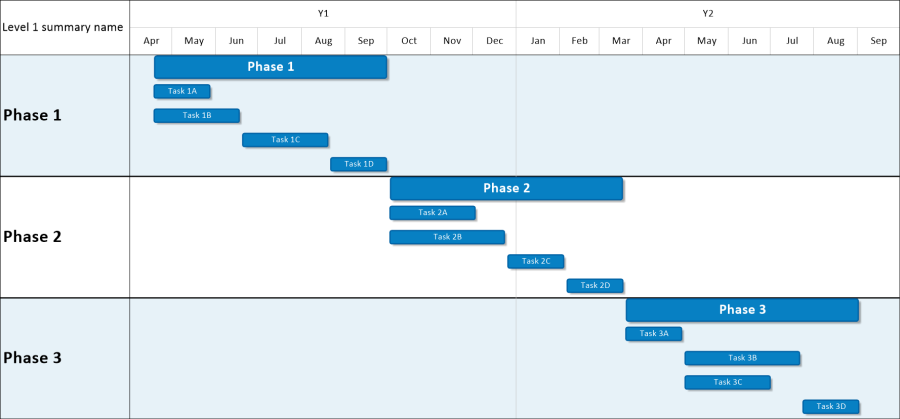
Click Next and then Create New Chart. OnePager will import your project from Smartsheet and give you a Gantt chart that initially looks something like this:
-
Our next step is to show the three budget columns from Smartsheet in our report. To do this, go to Home > Chart Properties > Rows/Swimlanes. For each of the three cost columns, turn on a Text Column in OnePager and format it to show currency:

-
Click OK, and OnePager will import your cost information from Smartsheet so that it displays like this:

Here, we have a column for the budgeted cost, a second column for the actual cost, and a third column for the cost variance, which is the difference between budgeted and actual cost.
-
The final step is to use conditional formatting to color-code the chart so that tasks are red when over budget and green when under budget. To do this, go to Home > Chart Properties > Task Bars and click the Manage Rules button. Here, we've set up a few rules that look at the Cost Variance field as the basis for color in the Gantt chart:
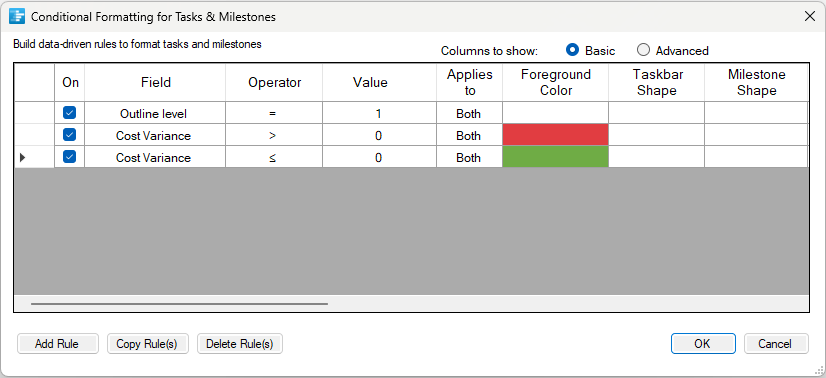
When the task is over budget, we'll color it red. When the task is on or under budget, we'll color it green. We also have a rule that assigns a different font and bar size to parent rows from Smartsheet.
-
Once the conditional formatting rules are applied and legend turned on, the final budget report looks like this:

Free Trial
Displaying Budgeted vs. Actual Cost Over Time
In addition to displaying columns for budgeted cost, actual cost, and cost variance, OnePager can also graph your cost over the life of your project. As we continue this example, we'll look at budgeted vs. actual cost month-by-month on an aggregate basis, so we can see whether the cumulative cost has come in over or under budget by the time the project is finished.
-
Go to Home > Chart Properties > Graphs/Data Cells. We'll create a two line graphs where the first series looks at the budgeted cost and the second series looks at the actual cost:
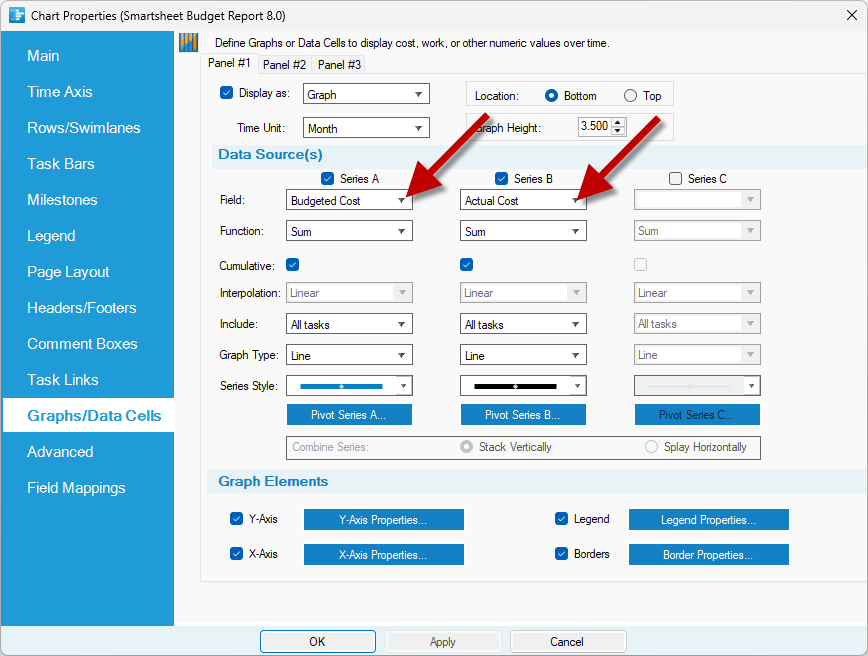
We'll render these two line graphs at the bottom of the Gantt chart, and will cumulatively sample the project on a monthly basis.
-
Click OK. OnePager will draw a blue line graph for the budgeted cost and a black line graph for the actual cost. Despite the cost variance that we see task-by-task in the Gantt chart above, the line graphs show that the total project cost over time is very close to the original budget:
Get started today by downloading a free trial, complete with our world-class customer support.
15-DayFree Trial
Related Articles
Microsoft Project Budget Report
Applicable Features
Some steps demonstrated in this article require use of OnePager's optional graphs and data cells feature, which is purchased separately from a standard license. All trial licenses receive complimentary access to graphs and data cells for fifteen days.